


New Hope Creek Preserve

*** 3/3/2026: TRAIL ALERT: One of the bridges on the New Hope Creek Bottomlands Trail is damaged. You will need to turn around when you get to this bridge. DO NOT ATTEMPT TO USE THIS BRIDGE. ***
NEW HOPE CREEK BOTTOMLANDS TRAIL
Address: 3791 Southwest Durham Dr. (Old Chapel Hill Road Park)
Hours: Open dawn to dusk year-round.
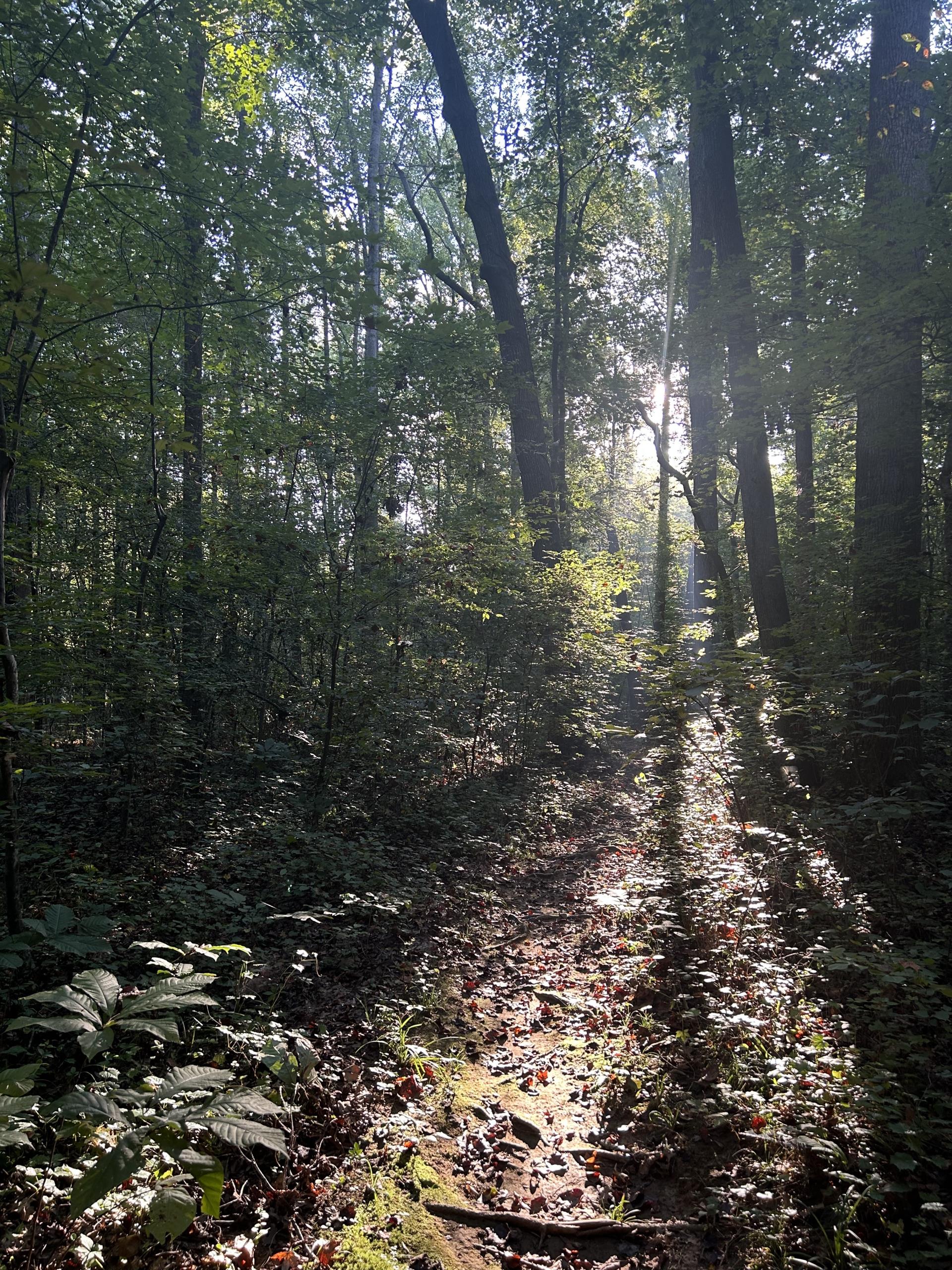
New Hope Creek Preserve contains one of the richest bottomland forests in central North Carolina and protects a vital wildlife corridor between Duke Forest and the Jordan Lake game lands. Visitors can access the southern part of the Preserve using the New Hope Creek Bottomlands Trail. This is an excellent place to explore a wild landscape in the heart of Durham.
Trail Information
The New Hope Creek Bottomlands Trail is an easy pedestrian loop trail consisting of boardwalk and natural surface tread. The trailhead can be accessed from the greenway at the City of Durham's Old Chapel Hill Road Park (3791 Southwest Durham Drive). The trail may be muddy after storms and during cooler months. In cases of significant flooding, the trail may be closed to the public.
About New Hope Creek Preserve
Durham County's New Hope Creek Preserve is home to the state-significant New Hope Creek Bottomlands Forest, one of the last remaining Piedmont floodplain forests in central North Carolina. This regional biodiversity hotspot and wildlife corridor has been the focus of citizen-led conservation efforts for decades, resulting in the protection of hundreds of acres of land along New Hope Creek and its tributaries since the early 1990s. Though the conservation of the New Hope Creek Corridor is one of our region's great conservation success stories, certain human-caused impacts pose serious threats to this delicate ecosystem and the many organisms who call it home.
A unique hardwood forest
The New Hope Creek Bottomlands Forest, which forms the core of New Hope Creek Preserve, is dominated by massive hardwood trees, many of which are hundreds of years old. Among the most prominent are twelve species of oaks, including Cherrybark oak (Quercus pagoda), an exemplary tree for bottomland forests. In the understory, a diversity of shrubs and smaller trees co-mingle, including Pawpaw, prized by humans and wildlife alike for its ripened fruit. An array of ferns, wildflower herbs, grasses, and sedges can be found in open areas dappled with sun. This area is also home to an extremely rare, State-listed species of hickory, the Shellbark Hickory (Carya laciniosa), ranked by the State's Natural Heritage Program as critically imperiled and found nowhere else in the state except a small population along the Roanoke River to the northeast. A 134-foot (41m) tall, 36-inch (91cm) wide shellbark, the largest in North Carolina, lives here in the Bottomlands, and is estimated to have started life around the year 1700. That's roughly 70 years before the United States declared independence from Great Britain!
Mature hardwood forests of this kind are uncommon in the Piedmont. Evidence from tree ages, forest composition, and aerial photography suggests that at least some parts of the Bottomlands Forest were never clearcut or converted to fields for agriculture. This has allowed the ecosystem's rich alluvial habitats, and their associated species, to flourish in a way that would not have otherwise been possible in a busy, rapidly-changing area like southwestern Durham County.
Biodiversity at the bottomlands
New Hope Creek Preserve is home to many unique and mysterious organisms. These organisms - everything from birds, mammals, and plants to insects, fungi, and slime molds - are precious cluse to our local natural history, and each play an important role in the Bottomlands. Scientists have spent decades researching this ecosystem and continue to make remarkable discoveries, including species that had never been found in the state. Two such species - a fungus and a leaf-mining insect - found during the comprehensive 2021-2022 New Hope Biodiversity Inventory turned out to be entirely new to science; the fungus, in the genus Russula, was given the name Russula neoelpidensis, from the Greek for "new hope."
The 2021-2022 biodiversity inventory of New Hope Creek Preserve and Hollow Rock Nature Park, which was conducted by the NC Biodiversity Project, supported by the Open Space Program, and funded in part by a grant from Burt's Bees, is among the most comprehensive such inventories ever conducted in the state and culminated in a 200-page report. Since its completion, many scientists and volunteers have continued to collect data at the Bottomlands through mapping studies, bird and insect surveys, and public citizen science projects.
a habitat - and a corridor - for wildlife
The importance of maintaining landscape connectivity - ensuring that natural areas are connected to one another - is fundamental to conservation. New Hope Creek Preserve is both a vital wildlife habitat (a place to live) and is part of a larger wildlife corridor (a way for animals to move between other habitats). However, New Hope Creek Preserve sits at a risky "pinch point" in this corridor, where increased development and busy roads can prevent animals from moving between and throughout their habitats. The protection of New Hope Creek Preserve has therefore helped limit habitat fragmentation along New Hope Creek.
Because the forest at New Hope Creek Preserve is protected, biologically diverse, and largely intact, it is home to an array of native wildlife, despite its urban setting. Beavers, otters, mink, foxes, coyotes, and bobcats have all been documented in the Preserve. The Preserve is also an important habitat for birds, including waterfowl and migratory songbirds, as well as amphibians, reptiles, and insects.
Staff, scientists, and volunteers document and monitor wildlife at New Hope Creek Preserve, in part to understand how changes in and near the Preserve may affect wildlife habitat. Data collected in recent years suggest that while this wildlife corridor remains largely intact and functional, a number of species appear to be on the decline, likely due to impacts from nearby development and land use change.